
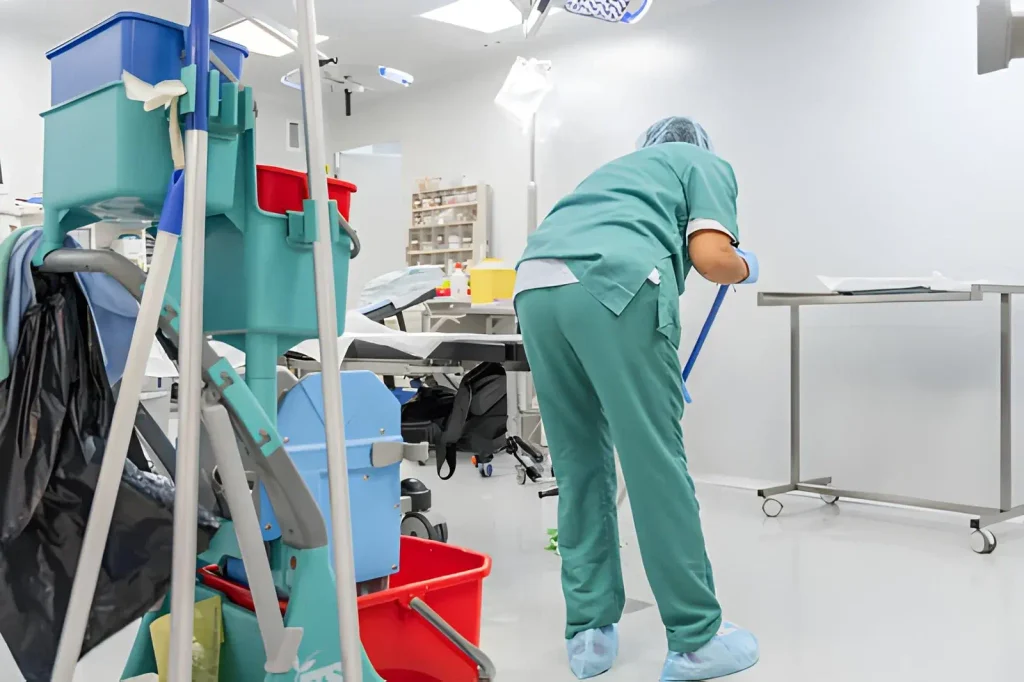
Healthcare facilities face a unique compliance challenge: cleaning protocols must satisfy OSHA’s bloodborne pathogen standards while protecting patient information covered under HIPAA. Compliance officers and practice managers who treat these two regulatory frameworks as separate concerns often create gaps that put their facility at risk during audits or inspections. Cleaning staff routinely encounter both biohazardous materials and protected health information, sometimes in the same room, during the same shift.
Understanding where these regulations overlap, and where they diverge, is the first step toward building a cleaning program that holds up under scrutiny. OSHA focuses on physical safety hazards like exposure to blood and bodily fluids, while HIPAA governs how patient information is accessed, stored, and disposed of. A facility’s cleaning staff often move between both categories of risk without clear protocols to guide them.
This article breaks down the specific regulatory requirements, cleaning and disinfection practices, and documentation standards that keep healthcare facilities compliant on both fronts. It also outlines how to train staff and build oversight systems that reduce liability over time.
Key Takeaways
- OSHA and HIPAA regulations intersect in healthcare cleaning and require distinct but coordinated compliance measures.
- Cleaning and disinfection protocols should be based on the level of risk present in each area of a facility.
- Ongoing staff training and clear documentation are necessary to sustain compliance and reduce liability over time.
Regulatory Foundations for Healthcare Cleaning
Two federal frameworks govern cleaning operations in healthcare facilities, each with distinct enforcement mechanisms and penalties. Compliance officers and practice managers must understand where these regulations apply separately and where they intersect during routine cleaning activities.
OSHA Worker Safety Requirements
OSHA’s Bloodborne Pathogens Standard (29 CFR 1910.1030) governs how cleaning staff handle blood and other potentially infectious materials. Facilities must provide personal protective equipment, including gloves, gowns, and eye protection, at no cost to employees.
Written exposure control plans are mandatory. These plans must identify job classifications with exposure risk and outline decontamination procedures for surfaces and equipment.
Employee training happens at hiring and annually thereafter. Documentation of this training must be kept for the duration of employment plus three years.
OSHA also requires proper labeling of biohazard waste containers and safe disposal procedures for sharps and contaminated materials. Violations carry fines that range from $16,131 to $161,323 per infraction, depending on severity and repeat occurrence.
HIPAA Privacy and Security Obligations
Cleaning staff frequently work in areas containing protected health information (PHI), including patient charts, prescription labels, and computer screens displaying medical records. HIPAA’s Privacy Rule requires facilities to limit incidental exposure to this information during routine cleaning.
Janitorial and environmental services staff who may encounter PHI often qualify as workforce members under HIPAA, requiring:
- Signed confidentiality agreements or business associate agreements (BAAs) for contracted vendors
- Documented privacy training before staff access patient care areas
- Clear protocols for handling misplaced documents or unsecured records found during cleaning
Facilities remain liable for HIPAA violations committed by third-party cleaning contractors if proper BAAs are not in place. Penalties range from $141 to $2,134,831 per violation category, based on the level of culpability determined by the Department of Health and Human Services.
Where Regulatory Responsibilities Overlap
Certain cleaning scenarios trigger both OSHA and HIPAA obligations simultaneously. Cleaning a patient room after discharge involves bloodborne pathogen protocols alongside proper handling of any paperwork or monitors displaying patient data.
| Scenario | OSHA Concern | HIPAA Concern |
| Disinfecting exam rooms | Surface contamination, PPE use | Charts or screens left visible |
| Waste disposal | Sharps handling, biohazard labeling | Shredding documents with PHI |
| Staff training | Exposure control education | Privacy and confidentiality rules |
Facilities that draft unified cleaning protocols, addressing both physical safety and information privacy in a single document, reduce the risk of gaps that lead to violations under either regulation.
Risk-Based Cleaning and Disinfection Protocols
Not every surface in a healthcare facility carries the same level of contamination risk, so cleaning protocols must be calibrated accordingly. OSHA’s Bloodborne Pathogens Standard and general infection control principles both call for a tiered approach that matches disinfection intensity to actual exposure risk.
Classifying Clinical and Nonclinical Areas
Facilities should sort spaces into risk categories before assigning cleaning procedures.
- High-risk clinical areas: exam rooms, procedure rooms, labs
- Moderate-risk areas: patient bathrooms, waiting rooms with direct patient contact
- Low-risk nonclinical areas: administrative offices, break rooms, hallways
High-risk areas require disinfection between each patient and often need EPA-registered hospital-grade products with tuberculocidal claims. Moderate-risk spaces typically need disinfection multiple times daily, focused on high-touch surfaces like door handles and armrests.
Low-risk nonclinical areas can follow standard commercial cleaning schedules, since they generally lack exposure to blood, bodily fluids, or patient-contact surfaces. Compliance officers should document this classification system in writing, since OSHA inspectors and HIPAA auditors both expect facilities to show a rationale behind cleaning frequency and product selection.
Managing Bloodborne Pathogen Exposure
Any surface with visible or suspected contact with blood or other potentially infectious materials (OPIM) falls under OSHA’s Bloodborne Pathogens Standard (29 CFR 1910.1030). This regulation requires specific decontamination procedures, not general cleaning.
Staff handling contaminated surfaces need personal protective equipment, including gloves and, where splashing is possible, eye protection. Contaminated cleaning materials must be disposed of as regulated medical waste, not standard trash.
Spill response protocols matter here too. A blood spill on a nonclinical surface, such as a waiting room floor, still triggers bloodborne pathogen procedures rather than routine janitorial cleaning.
Practice managers should keep an exposure control plan on file and update it annually. This plan should list which job roles face reasonably anticipated exposure and specify the decontamination steps required for each.
Selecting and Using EPA-Registered Disinfectants
Disinfectant selection is not optional or generic in a healthcare setting. Products must appear on the EPA’s registered list and carry claims appropriate to the pathogens of concern, such as claims against Clostridioides difficile or bloodborne pathogens like Hepatitis B.
Contact time listed on the product label is a compliance point, not a suggestion. If a disinfectant requires a 10-minute dwell time to kill target organisms, wiping a surface dry after two minutes does not meet the standard.
Facilities should maintain Safety Data Sheets (SDS) for every disinfectant in use, as required under OSHA’s Hazard Communication Standard. Staff training records should confirm employees know proper dilution ratios, application methods, and required contact times for each product used in their assigned areas.
Staff Training, Documentation, and Oversight
Compliant healthcare facility cleaning depends on trained staff, accurate records, and clear accountability across every vendor relationship. Practice managers need documented proof that both OSHA safety protocols and HIPAA privacy standards are followed consistently, not just understood in theory.
Personal Protective Equipment and Safe Work Practices
OSHA’s Bloodborne Pathogens Standard requires cleaning staff to use PPE appropriate to the exposure risk in each area. This typically includes:
- Nitrile or latex gloves for all surface contact
- Gowns or aprons when handling contaminated materials
- Eye protection during disinfectant application or spill cleanup
- Face masks in areas with airborne exposure risk
Staff must be trained on proper donning and doffing procedures to avoid cross-contamination. Training should also cover safe handling of sharps containers, spill response for bodily fluids, and correct disposal of regulated medical waste.
Retraining is required whenever procedures change or new equipment is introduced. Annual refreshers help reinforce these habits and reduce the likelihood of exposure incidents.
Cleaning Logs and Compliance Records
Detailed cleaning logs serve as evidence of compliance during audits or inspections. Each log entry should include the date, time, area cleaned, staff member’s name, and products or methods used.
For areas involving patient information, logs should note whether any exposed records were encountered and how they were secured. This creates a paper trail that supports both OSHA recordkeeping requirements and HIPAA’s documentation standards.
Digital logging systems reduce errors compared to paper records and allow faster retrieval during a compliance review. Records should be retained according to the facility’s data retention policy, typically a minimum of three years for OSHA-related documentation.
Vendor Accountability and Business Associate Considerations
Third-party cleaning vendors who may encounter protected health information (PHI) generally qualify as Business Associates under HIPAA. This means a signed Business Associate Agreement (BAA) is required before work begins.
The BAA should specify how staff handle exposed PHI, breach notification timelines, and data security expectations. Facilities should verify that vendors provide proof of OSHA-compliant training for their own employees, not just internal assurances.
Regular vendor audits confirm that contracted staff follow the same protocols expected of in-house employees. Facilities remain responsible for compliance gaps even when cleaning is outsourced, so vendor oversight cannot be treated as optional.
Building a Sustainable Compliance Program
A durable OSHA and HIPAA compliance program depends on consistent internal checks, clear response protocols, and reliable outside expertise. These three elements work together to reduce risk and keep facilities audit-ready year-round.
Routine Audits and Corrective Actions
Regular audits catch gaps before regulators or incidents do. Facilities should schedule internal reviews at least quarterly, covering cleaning logs, PPE inventory, disinfectant SDS availability, and staff training records.
Audit findings need documented corrective action plans with assigned deadlines. A finding without a follow-up date is just an observation.
Track recurring issues in a simple log:
| Issue | Root Cause | Corrective Action | Deadline |
| Missing SDS sheets | New product not logged | Update binder, retrain staff | 30 days |
| PPE shortage | Reorder threshold too low | Adjust inventory par levels | 14 days |
This creates a paper trail that demonstrates good-faith compliance efforts if OSHA or HHS ever requests documentation.
Incident Response and Exposure Reporting
Bloodborne pathogen exposures and PHI breaches both require immediate, documented response. Staff need a written protocol they can follow without hesitation, including who to notify first.
For exposure incidents, OSHA’s Bloodborne Pathogens Standard (29 CFR 1910.1030) requires post-exposure evaluation and follow-up within a defined timeframe. HIPAA breaches involving PHI have separate notification rules under 45 CFR 164.400-414, with timelines depending on the number of individuals affected.
Keep these processes distinct but coordinated:
- OSHA exposure: Report to supervisor, seek medical evaluation, document incident within 24 hours.
- HIPAA breach: Notify privacy officer, assess scope, determine notification obligations.
Cross-training cleaning staff on both protocols prevents delays that could worsen regulatory exposure.
Partnering With Specialized Healthcare Cleaning Providers
Not every janitorial company understands the overlap between infection control and patient privacy. Facilities benefit from working with vendors who train staff specifically on OSHA bloodborne pathogen standards and HIPAA’s minimum necessary rule.
A qualified provider should offer signed Business Associate Agreements when cleaning staff may encounter PHI, such as documents left on desks or visible screens. They should also maintain their own SDS binders, PPE stock, and incident reporting forms that align with the facility’s existing systems.
Ask potential vendors for proof of staff training records and references from other healthcare clients. This vetting step reduces the chance of gaps between what the facility expects and what the cleaning team actually delivers.