
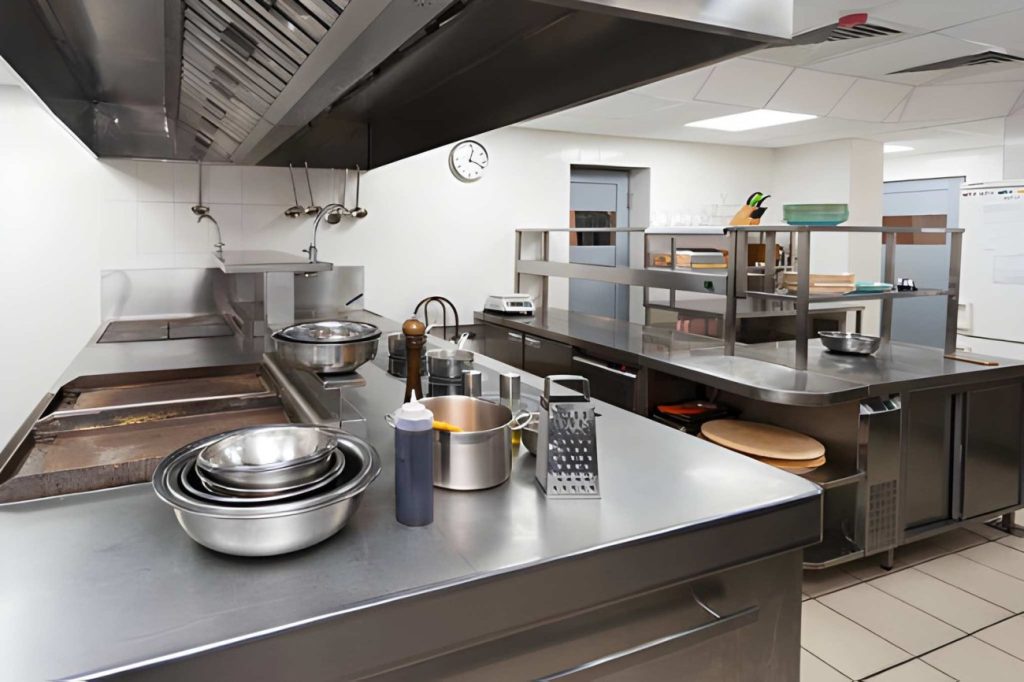
Most kitchen hood cleaning services focus on the hood canopy and ductwork, but the filters are a separate component that requires its own cleaning routine. Skipping filter maintenance while cleaning the rest of the hood leaves a major gap in your fire safety and ventilation system.
Hood filters are the first line of defense against grease entering your exhaust system, and when they are clogged or coated in grease buildup, they stop working — putting your kitchen at risk for fire, poor air quality, and failed inspections.
Filters that are neglected long enough can also force your exhaust fan to work harder, reduce airflow efficiency, and create compliance issues under standards like NFPA 96. This article breaks down exactly why filters need dedicated attention separate from general hood cleaning.
Key Takeaways
- Hood filters serve a specific function in trapping grease before it reaches the ductwork, making them a critical safety component on their own.
- Dirty or clogged filters reduce ventilation performance and increase fire risk even when the rest of the hood system appears clean.
- Neglecting filter maintenance can lead to failed health inspections, fire code violations, and costly damage to your exhaust system.
Critical Functions of Hood Filters
Hood filters are the first line of defense in a commercial kitchen ventilation system, directly controlling grease buildup and maintaining safe air flow before contaminants reach the ductwork.
Role in Ventilation and Fire Safety
Hood filters sit between the cooking surface and the exhaust duct, physically intercepting grease-laden air before it travels further into the system. Without functioning filters, grease accumulates inside the ductwork itself — a surface that is far harder to clean and far more dangerous to ignore.
Grease deposits inside ducts are a leading cause of commercial kitchen fires. A clogged or missing filter allows those deposits to build up faster, increasing fire risk significantly.
Filters also affect airflow volume. When they become heavily loaded with grease, the ventilation system has to work harder to pull air through, reducing exhaust efficiency. This can cause:
- Heat and smoke buildup at cooking surfaces
- Reduced negative pressure inside the hood
- Higher stress on exhaust fans, shortening equipment lifespan
Impact on Grease Control and Air Quality
Filters physically capture grease particles suspended in cooking vapors through a process called impingement — air changes direction rapidly through the filter baffles, and grease droplets collide with and stick to the metal surfaces.
This keeps grease out of the duct system and out of the air that kitchen staff breathe. A saturated filter loses its ability to capture new grease, allowing particles to pass through unchecked.
The result is grease migrating into the exhaust duct, and cooking smoke, odors, and fine particulates circulating back into the kitchen environment. Both outcomes are preventable with consistent filter cleaning.
Consequences of Ignoring Filter Maintenance
Dirty hood filters lead to fire hazards, degraded ventilation performance, and failed health inspections — all of which carry real financial and operational costs.
Increased Fire Hazards
Grease doesn’t just coat the filter — it saturates it. When a filter is fully loaded with grease, it stops capturing new grease particles and allows them to pass through into the exhaust duct. That buildup inside the duct is highly flammable.
Most commercial kitchen fires originate in the exhaust system, and clogged filters are a primary contributing factor. A grease fire that reaches the ductwork can spread quickly and is difficult to suppress with standard suppression systems.
Filters that are cleaned on a regular schedule — weekly or bi-weekly in high-volume kitchens — significantly reduce the rate of grease accumulation in the duct system.
Decreased Efficiency and Equipment Lifespan
A clogged filter restricts airflow through the hood. When airflow is restricted, the exhaust fan works harder to pull air through, which increases energy consumption and puts mechanical strain on the fan motor.
Over time, this leads to:
- Premature fan motor failure
- Increased utility costs from the system running at higher capacity
- Poor smoke and odor capture, leaving cooking fumes in the kitchen air
- Heat buildup near cooking equipment due to inadequate ventilation
Filters that are neglected long enough can also become structurally damaged and require full replacement rather than cleaning — a more expensive outcome than routine maintenance.
Compliance Risks and Regulatory Issues
Commercial kitchens are subject to inspection under NFPA 96, the standard for ventilation control and fire protection in commercial cooking operations. This standard requires that filters be maintained in a clean condition.
A failed inspection due to dirty filters can result in:
| Consequence | Impact |
| Fines | Immediate financial penalty |
| Forced closure | Loss of revenue during shutdown |
| Insurance denial | Claims may be voided if negligence is found |
| Re-inspection fees | Added cost to return to compliance |
Health departments and fire marshals both have authority to act on filter violations. Staying current on filter cleaning is one of the more straightforward ways to avoid compliance issues during routine inspections.